Conventional vs. FHA Loans in MN: A Plain-English Breakdown
MN Home Buyers Connection
September 7, 2026
When deciding between a Conventional and an FHA mortgage, the choice typically comes down to your credit profile, down payment savings, and long-term financial goals. Navigating the Conventional vs FHA decision is a common first step for many buyers looking at Minnesota mortgages. According to the National Association of Realtors, conventional financing is the most common choice, accounting for roughly 70% of all homebuyers. Yet, FHA loans remain a powerful tool, helping over 800,000 Americans achieve homeownership last year based on reports from the Department of Housing and Urban Development. Neither option is universally better; the right choice relies entirely on matching your unique financial reality to the correct program. Let us break down these two popular mortgage options in plain English.
What Is a Conventional Loan?
A Conventional loan represents private financing that is not directly insured by the federal government. Private lenders issue these mortgages, operating under strict underwriting guidelines established by Fannie Mae or Freddie Mac. When applying for a Conventional loan Minnesota lenders will look closely at your credit history and debt-to-income ratio. Because these guidelines rely on conforming loan limits that change annually based on region, buyers can verify their local borrowing caps using the FHFA Conforming Loan Limit Values Map to see exactly how much financing they can secure in their specific Minnesota county.
These conventional avenues remain favored because they supply high financial flexibility for buyers who maintain steady credit histories. The primary advantages include:
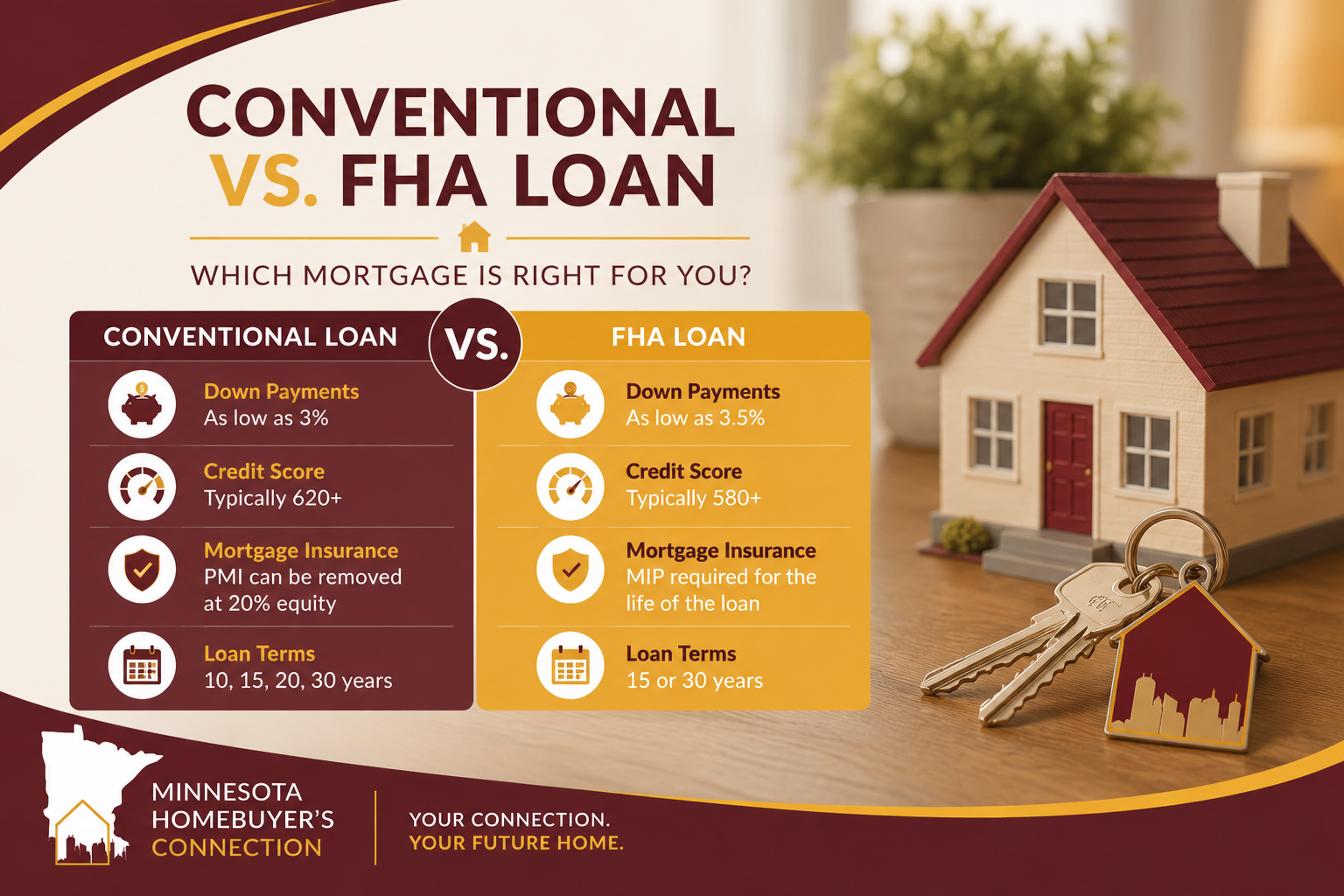
Down payments as low as 3% for qualified buyers
Favorable interest rates tied directly to your credit score
Adjustable loan terms spanning from 10 to 30 years
The opportunity to drop private mortgage insurance (PMI) once you build 20% home equity
What Is an FHA Loan?
The Federal Housing Administration provides the backing for FHA mortgages. Originally introduced during the Great Depression to stimulate a struggling housing market by protecting lenders from defaults, the FHA loan remains a cornerstone of affordable homeownership today. As explained in a detailed overview by Movement Mortgage, federal insurance reduces the risk for private lenders, allowing them to grant approvals with softer financial constraints. This makes an FHA loan Minnesota a highly accessible option for buyers who may not qualify for conventional terms.
Many buyers comfortably align with FHA qualifications for practical reasons. An FHA setup is often the best route if you:
Have a lower credit score (often in the 580 to 620 range)
Have a smaller accumulation of personal cash reserves
Require more flexible debt-to-income limits
Are rebuilding your financial standing after past credit challenges
Comparing the Fundamental Requirements
Examining down payments and credit expectations reveals the practical differences you will experience when applying for a home loan, especially if you are a First-time homebuyer navigating the market for the first time.
Down Payment Levels
Conventional buyers with strong financial profiles can enter the market paying only 3% down. Alternately, most buyers qualify for an FHA program by offering at least 3.5% down, depending on base credit benchmarks. To put this in perspective, on a $200,000 home purchase, a traditional 20% down payment requires $40,000 upfront. By contrast, a 3.5% FHA down payment reduces that initial requirement to just $7,000 (excluding closing costs). While a 0.5% gap looks insignificant upfront, knowing which set of lending rules will ultimately grant you an approval is what matters most. Working with a local expert who understands Minnesota mortgages can help you identify down payment assistance programs that lower these upfront costs even further.
Credit Standards
Conventional lenders rely heavily on tiered pricing. A superior credit score unlocks cheaper borrowing terms and lower monthly insurance costs. An FHA program treats candidates with standardized rates. Under FHA guidance, a slightly lower credit score restricts your buying capacity much less than standard conventional pricing metrics would.
Mortgage Insurance Distinctions
Your mortgage insurance determines some of the most significant long-term financial shifts away from your introductory payment estimates.
The Conventional PMI Approach
Borrowing more than 80% of a home's value applies a temporary Private Mortgage Insurance (PMI) fee automatically. This cost is not permanent. Once your loan balance falls to 80% of your property's value, you can request PMI cancellation, dropping a significant monthly expense.
The FHA MIP Format
Securing an FHA agreement demands both a preliminary upfront Mortgage Insurance Premium (MIP) paid at closing, and continuous annual charges divided into your monthly payments. For borrowers supplying a minimum down payment, these charges follow an exact lifetime requirement that cannot be canceled unless you refinance into a conventional loan later. If you want to compare the long-term costs of Conventional vs FHA options for your specific situation, visiting MN Home Buyers Connection can help you match with a local specialist to explore your options.