How to Qualify for MN Down Payment Assistance for Homebuyers
MN Home Buyers Connection
September 7, 2026
Saving for a down payment remains the primary barrier to homeownership for 38% of first-time buyers, according to the National Association of Realtors. However, eligible buyers in the state can often access up to $18,000 in upfront financial assistance through various regional and statewide funding mechanisms. For a first-time homebuyer MN offers a diverse portfolio of local initiatives designed to lower entry barriers. By leveraging these local programs, you can significantly reduce the cash required at closing and transform an otherwise overwhelming process into a financially favorable outcome.
Understanding Minnesota Down Payment Assistance
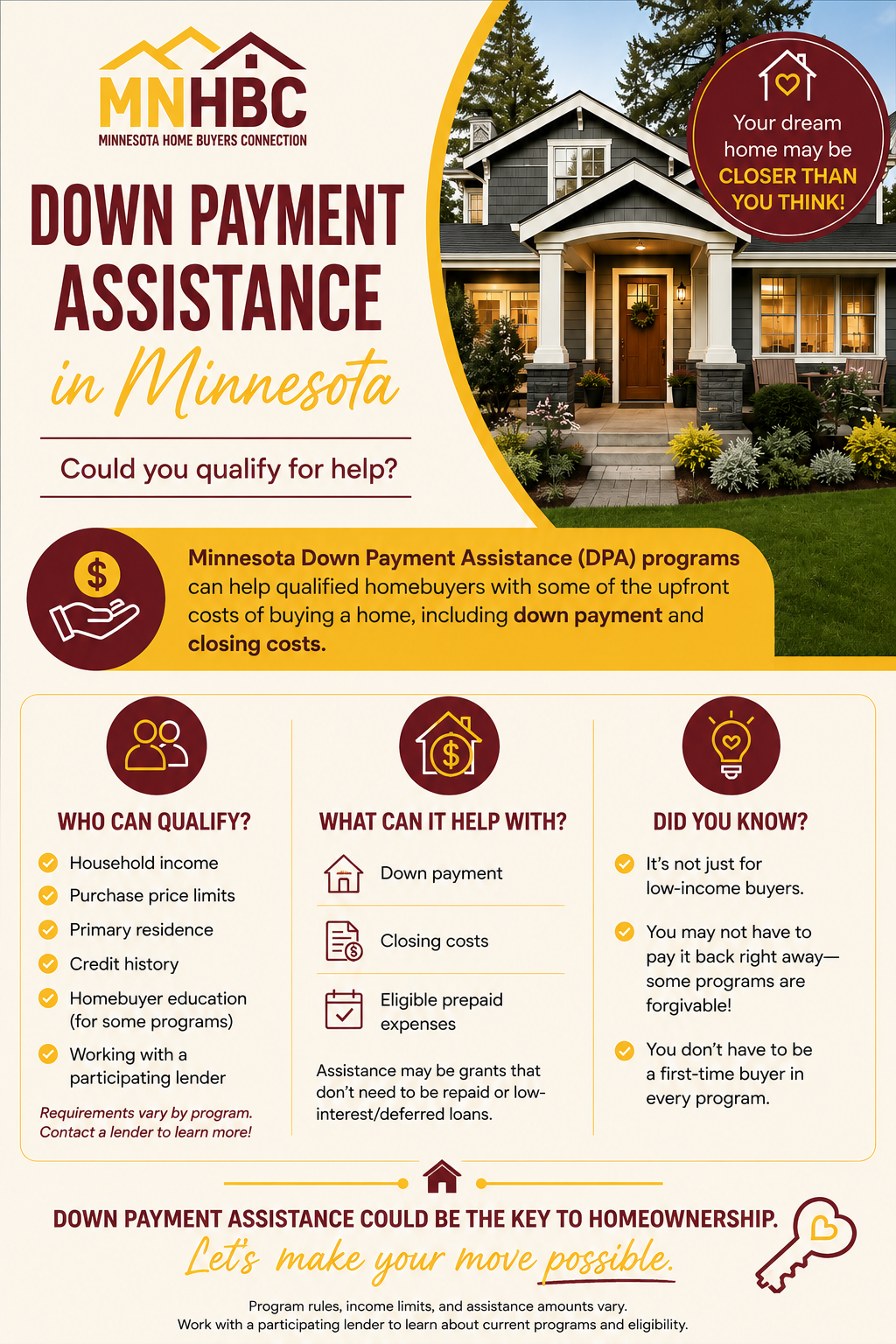
Down payment assistance refers to specialized financial tools designed to help homebuyers manage the steepest upfront costs of purchasing a property. Instead of completely depleting your savings, Minnesota down payment assistance can effectively cover your initial deposit, standard closing costs, and sometimes eligible prepaid mortgage expenses.
State agencies and local municipalities offer structured programs to make housing more affordable. For example, the Minnesota Housing Finance Agency provides robust loan options of up to $18,000 for qualifying buyers. Working with a dedicated local loan officer ensures you can navigate these specialized financial products smoothly. Their local expertise helps keep your savings intact for essential property maintenance, moving expenses, or emergency funds.
Core Down Payment Assistance Qualifications
Securing these advantageous funds relies on meeting specific down payment assistance qualifications. While exact requirements vary by municipality and lending institution, most program approvals depend on a standard set of criteria:
- Household Income Limits: Income caps are scaled by county. For example, the state's flagship Start Up program allows household incomes up to $156,100 depending on the county.
- Purchase Price Limits: Homes must fall under designated price thresholds. Under state guidelines, the purchase price limit is capped up to $515,200 in the 11-county Twin Cities Metro area, and $472,030 for all other counties. Local county programs, such as the Ramsey County FirstHome Down Payment Assistance Program, may set distinct limits, such as a maximum purchase price of $372,600 for properties within suburban Ramsey County.
- Occupancy plans: The property must serve as your primary, owner-occupied residence.
- Credit and Debt Metrics: Borrowers must meet minimum credit score standards and maintain acceptable debt-to-income ratios.
- Homebuyer Education: At least one qualifying borrower must complete an approved homebuyer education course, such as Home Stretch or the online Framework platform, prior to closing.
Many buyers falsely assume that you must be purchasing your very first home to participate. In reality, according to guidelines from the U.S. Department of Housing and Urban Development (HUD), multiple localized initiatives define a first-time buyer simply as someone who has not held an ownership interest in a principal residence during the past three years. Furthermore, repeat buyers who exceed first-time buyer income limits can often find alternative pathways, such as the Minnesota Step Up program.
Exploring Available MN Housing Grants and Loan Structures
Minnesota home buying programs utilize a variety of financial structures to support your purchase. These structures dictate whether the upfront funds require repayment and under what timeline.
Forgivable Loans and Grants
Some localized funding comes in the form of MN housing grants or forgivable loans. If you live in the home for a predetermined number of years and meet all institutional guidelines, the debt is completely forgiven, meaning you never have to repay those initial funds. These structures are especially common in community-level plans targeted at closing equity gaps, including specialized First-Generation Homeownership Programs designed to assist buyers whose parents do not own a home.
Deferred Payment Loans
Other assistance operates as a deferred loan. These highly favorable, zero-interest loans typically require no monthly payments. They are only repaid when you eventually sell the home, refinance your mortgage, or pay off the primary loan entirely.
Disproving Common Home Financing Myths
Financial complexities often breed misconceptions. Local mortgage experts frequently guide clients past these common misunderstandings to reach successful closings:
- Assistance is strictly for low-income buyers. Many programs specifically target moderate-income earners and middle-class families. Eligibility relies on balancing your income against specific program caps, which can be quite generous—reaching over $150,000 in certain areas.
- The application process delays closing. Partnering with a loan officer who specializes in Minnesota-specific programs ensures that qualifying and applying for assistance fits seamlessly into your standard closing timeline without unnecessary delays. Your loan officer will package and submit all required documentation directly to the county or state program on your behalf.
- You must pay everything back immediately. As noted above, many structures delay repayment for decades or forgive the balance completely over time.
Frequently Asked Questions
Can I combine multiple assistance programs?
In many cases, yes. Buyers can often layer statewide initiatives with county or city-level grants. A local mortgage expert can analyze your profile to stack compatible benefits, maximizing your total financial aid.
Are there purchase price limits for eligible homes?
Yes. The majority of assistance programs cap the maximum allowable purchase price. These limits generally reflect the average home prices in the targeted county and are updated annually. For example, municipal limits may range from approximately $372,600 for specific county programs up to $515,200 for state metro programs.
Do I have to use a specific lender to get assistance?
Yes, accessing state and local assistance requires working with an approved, participating lender. Connecting with a qualified local loan officer is the most critical step in establishing a favorable financial strategy, as they must submit the files and clear the administrative requirements for you.
How long does the required homebuyer education course take?
Most approved courses take about eight hours to complete. Available both online (such as Framework) and in person (such as Home Stretch workshops), these courses provide crucial insights into ongoing homeownership responsibilities, property taxes, and routine maintenance.
Take the Next Step Toward Your Minnesota Home
Instead of letting the complexity of mortgage products delay your goals, you can take action today. Identifying your matching programs begins with a simple assessment of your current financial footprint and local county preferences.
At MN Home Buyers Connection, our proprietary matching system bridges the gap between your real estate goals and the local mortgage professionals who know how to secure these funds. By participating in our interactive process, we can connect you with a neighborhood expert who will build a tailored, comprehensive roadmap for your purchase.
Visit mnhomebuyersconnection.com to complete our secure homebuyer survey. Discover your customized matches for local aid and let a dedicated local professional turn the hurdle of an upfront down payment into a successful, cost-saving closing.